Frozen Bins and Circular (Economy) Dreams
Welcome back to the (frozen) bins, Decomposers,
I missed you!
I return as well rested as possible and freshly graduated from the Sanitation Foundation’s Trash Academy — an incredible (free!) deep dive into New York City’s waste systems. Learning where our trash actually goes, and how sanitation quite literally shaped this city, was both fascinating and horrifying in the way only infrastructure can be.
One concept that came up repeatedly was NYC’s push toward a circular economy, a system designed to keep materials in use for as long as possible, extracting their maximum environmental and economic value before returning them safely to the earth.
While I highly recommend Trash Academy, compost got far less attention than I would have liked. Maybe I’m biased. Fine. I’m biased. But the omission sent me right back here. (Yay!)
Because community gardens? We are already operating circular systems. (I know, I’ve said this before!)
I’ve been on winter hiatus with the Maple Street Community Garden Coordinating Committee, planning and organizing the upcoming season. Scrap drop-off will resume. Flowers will bloom. A newsletter will find its way into your inbox next month. The Fundraising and Arts committees are cooking up magic. This season is going to be special.
Yes, the soil is currently frozen solid. It might actually be thawing as I type this but I digress.
Either way, spiritually? Thriving.
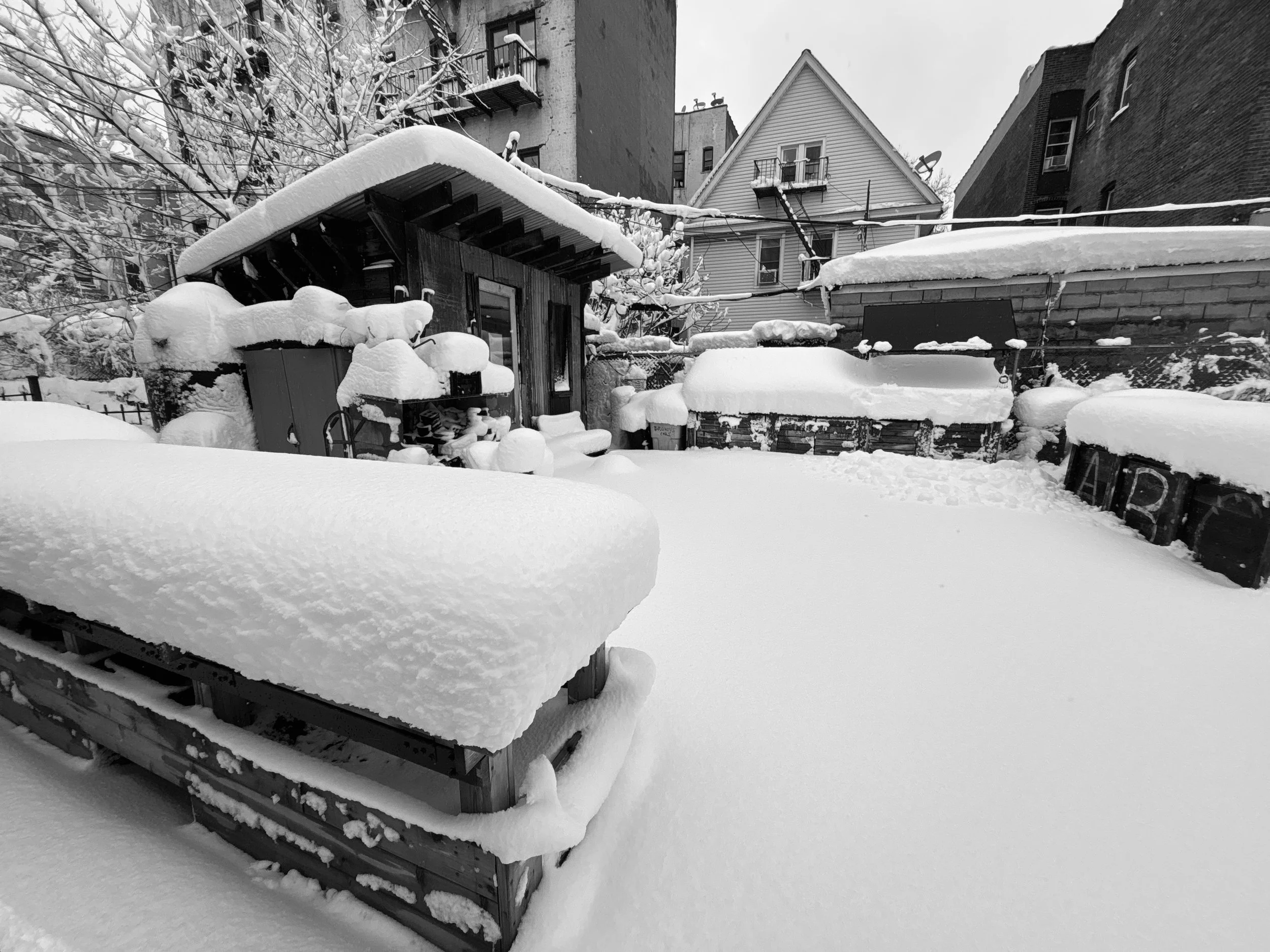
photo by Jess Frost
I’ve been part of the NYC community garden world for a while now, and what keeps me invested is this: gardens are not decorative. They are infrastructure. Physical infrastructure. Social infrastructure. Climate infrastructure. They hold food access, education, resilience, and actual community.
This blog is called Compost Corner, and I would never be bold enough to call myself a Gardener (gardeners are sorcerers). I am simply a compost enthusiast with an edger and strong opinions.
Here’s the reality: even with NYC’s curbside compost rollout expanding citywide, participation and processing capacity are still catching up. And will be for the foreseeable future.
When food scraps go to landfill, they decompose without oxygen and create methane (ew), a greenhouse gas far more potent than carbon dioxide. Composting, by contrast, is an aerobic process. Managed correctly, it significantly reduces methane emissions and returns nutrients to the soil.
Some NYC organics are now sent to anaerobic digesters, where they intentionally produce biogas that can be captured for energy. That’s powerful technology (when the infrastructure and scale are there to support it safely and efficiently).
But large-scale systems take time. Decades, even.
Community composting is immediate. (Even if the city budget kinda ghosts us sometimes.)
At Maple Street Community Garden, we operate a small but mighty circular loop. We intercept food scraps, create compost locally, use that compost to grow food and flowers, harvest the growth, share it with neighbors, and return plant matter back to the bins. Scraps become soil. Soil grows food. Food feeds people. People bring back scraps.
Closed loop. Human scale. Climate action you can hold in your hands.
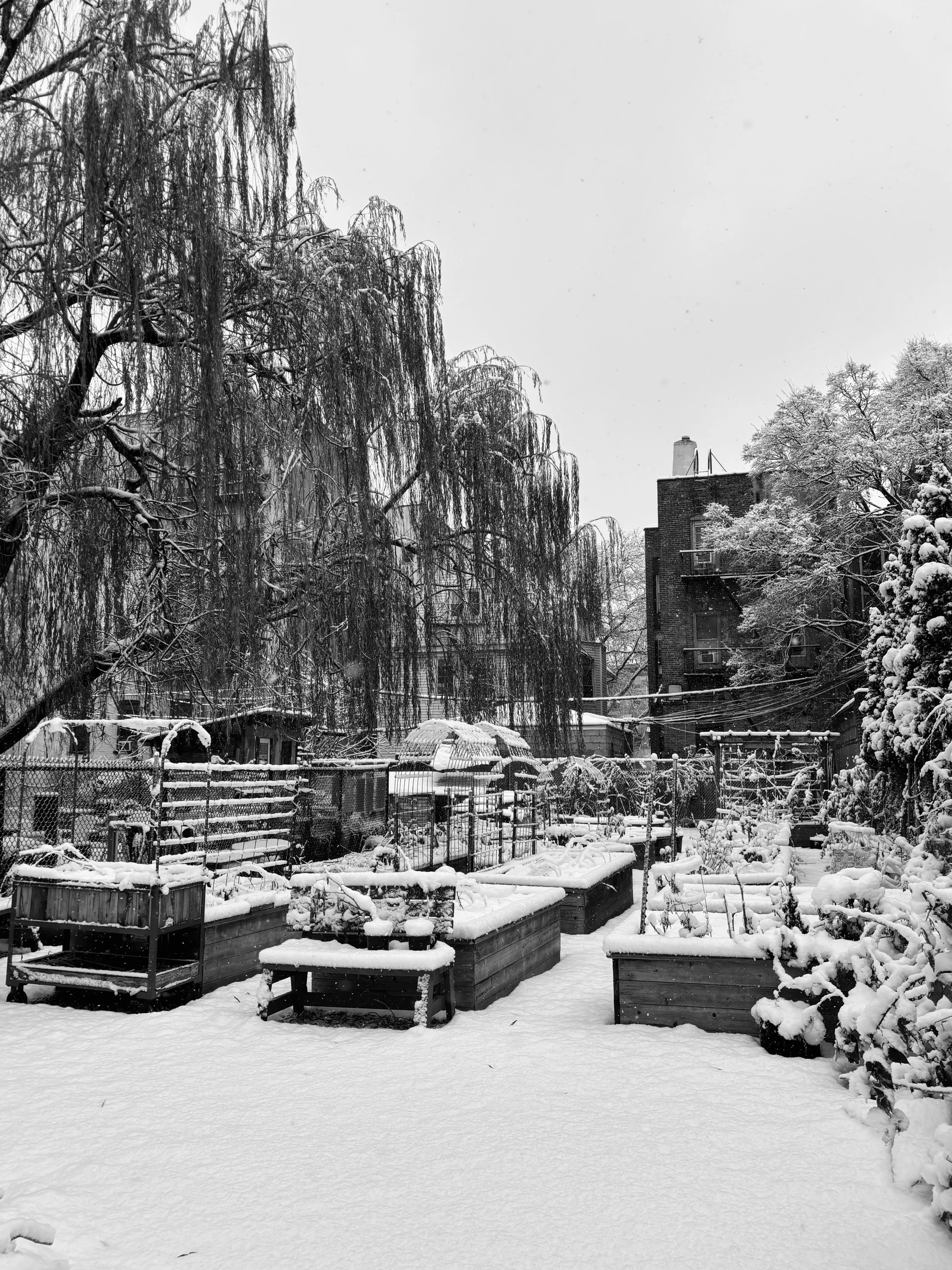
photo by Jess Frost
And here’s something else I keep thinking about: education.
Community gardens are some of the only places where children can see decomposition happen in real time. Educators and parents can lean into composting early, not as an abstract environmental concept, but as something tactile and alive. A jack-o-lantern transforms. Christmas trees are mulched. Steam rises from a hot pile. Worms do their quiet work. Kids learn that waste is not the end of a story, it’s a stage in a cycle.
If we want a city that understands circular systems, we have to raise people who’ve witnessed one.
(And if you’re reading this blog, I encourage you to consider NYC’s free Master Composter Certification Program)
While the city builds out large-scale infrastructure to address climate change, community gardens are already modeling the circular economy block by block. They are not side projects. They are cost-effective, existing systems that reduce waste, build soil health, strengthen food access, and create third spaces in neighborhoods that are too often overlooked.
We don’t need to invent this model. It’s here. It’s half-built. It’s frozen in this winter but thriving in spirit.

photo by Jess Frost
Our MSCG bins are still on winter hiatus, but make sure you’re subscribed to the newsletter for reopening updates (APRIL 4th, 2026). In the meantime, if you’re local, you can drop scraps at Nurture BK on Ocean Avenue by the Parkside entrance to Prospect Park from 9–11am on Sundays.
As winter thaws into spring, I’m looking forward to workshops, events, and an aggressively joyful amount of chopping. With my beloved edgers.
See you at the bins.
Your favorite future compost,
Jess Frost, Master Composter
Co-Coordinator, MSCG Communication Committee